

Best Desk Accessories for Cozy Office Spaces
Table of Contents
- Best Desk Accessories for Cozy Office Spaces
- Cozy Drinkware That Makes Work Feel Intentional
- Aesthetic Desk Setup Ideas You Can Actually Use
- Cute Stationery for Office Spaces That Feel Personal
- Desk Organization Tips for Productivity and Calm
- Small-Space and Renter-Friendly Desk Accessories
- How to Choose Accessories That You'll Actually Use
- Conclusion
- Frequently Asked Questions
Last Updated: October 5, 2026
Best Desk Accessories for Cozy Office Spaces
Creating a workspace that feels intentional doesn't require a complete overhaul. The best desk accessories for cozy office spaces combine function with personality, turning an ordinary desk into somewhere you want to spend time.
At Kittlins, we know the details matter. A beautiful notebook, a warm mug, or a small plant can shift your relationship with your workday.
Cozy Drinkware That Makes Work Feel Intentional
Your morning coffee tastes better in a mug that makes you smile. Drinkware is one of the easiest ways to add personality to your desk because you touch it all day.
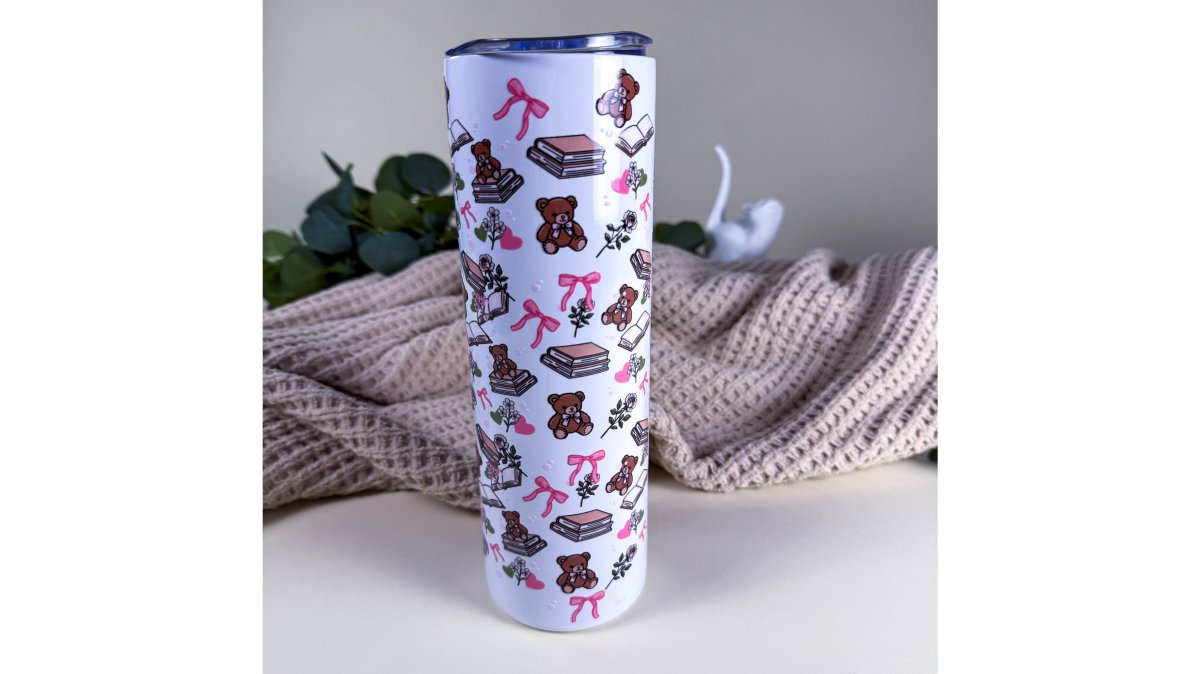
The Bears & Books 30 oz Tall Skinny Stainless Steel Tumbler ($32.00) holds enough coffee for a full work session and keeps drinks at the right temperature from first sip to last.

For something lighter and more portable, the Cozy Is My Vibe 16 oz Frosted Glass Can ($22.00) comes with a bamboo lid and reusable glass straw.

If you prefer stainless steel year-round, the Tropical Cats 20 oz Holographic White Stainless Steel Tumbler ($28.00) brings a different energy.

Aesthetic Desk Setup Ideas You Can Actually Use
An aesthetic desk isn't about perfection. It's about creating an environment where you feel calm and motivated, so everything on it earns its space.
Start with a focal point. The Bears & Books Pink Holographic Notebook ($8.00) has 160 college-ruled pages and a cover that shifts in the light.
If you want something brighter, the Bubbles, Butterflies & Cats Holographic Notebook ($8.00) features playful kittens, butterflies, and duckies on a shimmering holographic cover, with a matte black-and-white interior that keeps your writing free of visual clutter.
For a tropical aesthetic, the Tropical Cats Pink Paradise Holographic Notebook ($10.00) wraps 160 pages in soft pink tones, plumeria, and hibiscus. It's ideal for a space with warm, natural light.
Pair your notebook with a pen you love, a bookmark, and maybe a small plant. The goal isn't to fill every inch of your desk, it's to create pockets of beauty.
Cute Stationery for Office Spaces That Feel Personal
Stationery does something most office supplies don't: it makes you want to write things down. A beautiful pen or a thoughtful sticker can transform how you approach note-taking.
Vinyl stickers are a low-commitment way to personalize your space. The Cute Bee Vinyl Glossy or Holographic Sticker ($3.50) is hand-drawn and waterproof, perfect for laptop lids, water bottles, or planners.
The I Love You Very Mush Vinyl Sticker ($4.00) is for anyone who appreciates a good pun.
For plant lovers, the Alocasia Pink Venom Vinyl Sticker ($4.00) captures the moment of spotting a rare pink variegated leaf.
The beauty of stationery is that it's functional. You're not just decorating, you're using tools that make your work feel more intentional.
Desk Organization Tips for Productivity and Calm
Organization isn't about minimalism. It's about knowing where things are and creating visual calm so your brain can focus. Match the storage to how you actually work, not to a photo of someone else's desk.
Start with a working-zone map
Most ergonomic guidance divides a desk into three zones, a useful way to decide what stays out:
- Primary zone (about 0-16 inches from your body): only what you touch every hour, keyboard, mouse, pen, notebook, drinkware.
- Secondary zone (about 16-30 inches): items you reach for daily but not constantly, a planner, a charging cable, a small tray of stickers.
- Reference zone (beyond arm's reach): things you need weekly or monthly, extra notebooks, reference books, backup supplies.
If something in the primary zone isn't touched daily, move it back a zone. That single rule clears more visual noise than any bin system.
Give every category a home
Grouping similar items works, but only if each group has a defined container or footprint:
- A single pen cup beats a scattered pen pile. Keep two or three pens you actually like and store refills elsewhere.
- A shallow tray (roughly 6 by 9 inches) corrals stickers, bookmarks, and small clips without becoming a junk drawer.
- A vertical file or magazine holder keeps notebooks upright so covers stay visible and you actually reach for them.
- A small lidded box for cables and adapters keeps the tangle out of sight but still within the secondary zone.
Use negative space deliberately
Empty surface area isn't wasted space, it's what makes a desk read as calm. A common guideline is to keep roughly a third of your desktop clear at the end of each workday, so the eye has somewhere to rest.
A desk pad helps here. A felt or leather pad around 24 by 14 inches defines your writing surface and gives you a boundary: items that drift past the edge are drifting into clutter.
Reset daily, not weekly
A two-minute end-of-day reset, return pens to the cup, stack notebooks, move your mug to the kitchen, prevents the slow accumulation that turns a tidy desk chaotic by Friday. Weekly, move anything untouched in a month to the reference zone or a drawer.
Tropical Cats 20 oz Holographic White Stainless Steel Tumbler →
Match the material to the job
- Felt pads are quiet and warm but can pill over time; they're best for writing surfaces, not for holding heavy items.
- Wood trays are sturdy and age well, but they're heavier and less forgiving if you like to rearrange often.
- Wire or acrylic holders keep contents visible, which helps if you forget what you've stored, but they show dust more readily.
None of these is universally better. The right choice depends on whether you value quiet, durability, or visibility most.
Small-Space and Renter-Friendly Desk Accessories
Most cozy-desk roundups assume you have a full room. If you're on a folding table in a shared apartment, a dorm desk, or a corner of the living room, the constraints, and the accessories that help, are different.
Measure before you buy
A standard desk is about 48 to 60 inches wide and 24 inches deep. A small desk is often 30 to 40 inches wide, and a laptop stand or monitor can eat 8 to 10 inches of that depth. Before adding anything, measure:
- Usable depth after your laptop or monitor is in place.
- Usable width after your keyboard and mouse.
- Vertical clearance if you want a riser or shelf.
Accessories that fit a 60-inch desk often overwhelm a 36-inch one. A 24-by-14-inch desk pad can cover most of a small desk's writing area, so a 20-by-12-inch pad may fit better.
No-drill and damage-free options
Renters can't count on putting holes in walls. A few no-drill approaches:
- Adhesive hooks and strips rated for the weight you're hanging. Check the package rating; a hook rated for 1 pound won't hold a loaded tote.
- Over-the-door or over-cabinet organizers for supplies that don't need to live on the desk.
- Freestanding shelves that lean or clamp rather than mount.
- Clamp-on desk lamps and monitor risers that grip the desk edge instead of the wall.
- A rolling cart (often about 24 inches tall and 16 inches wide) that tucks beside the desk and rolls away when you need the floor space.
Choose items that do double duty
In a small space, every object should earn its footprint:
- A monitor riser with a drawer lifts your screen to a more comfortable height and stores pens or cables underneath.
- A lidded mug or tumbler doubles as a place to stash pens when it's empty, though a dedicated cup is cleaner.
- A notebook with an elastic closure keeps loose papers from sliding out, so it can act as a folder and a journal.
- A clip-on task light frees desk surface entirely and can move with you if you relocate.
Portable and packable setups
If your desk is also the dining table, look for accessories that pack down fast:
- A roll-up desk mat stores flat or in a drawer.
- A soft pencil case holds pens, stickers, and a small notebook as one grab-and-go kit.
- A folding laptop stand collapses to roughly the size of a book.
Keep the visual weight low
In a small space, a few well-chosen pieces read as intentional; many read as cramped. Pick one focal item (a notebook, a plant, a lamp), one functional item (a tray or riser), and one comfort item (a mug or wrist rest), then stop. Rotate seasonally rather than accumulating.
Renter-friendly personalization
Stickers, removable decals, and washi tape let you personalize a laptop, water bottle, or lamp without touching the walls. They're also the cheapest way to test a color palette before committing to larger pieces. If you're unsure about a design long-term, start with one small sticker and live with it for a week.
How to Choose Accessories That You'll Actually Use
The difference between desk accessories you love and ones that become clutter is simple: will you actually use them?
Before buying anything, ask: Do I use this category of item daily or weekly? A mug you'll drink from every morning is worth investing in.
Consider your work style. If you're constantly taking notes and planning, notebooks and stickers matter.
Think about aesthetics that last.
Quality matters more than quantity. One beautiful notebook you'll use for months beats five cheap ones that fall apart.
Finally, be honest about your habits. If you buy cute things and never use them, start small: one notebook, one mug, a few stickers.
| Accessory Type | Best For | Key Consideration |
|---|---|---|
| Drinkware | Daily use, comfort | Hand wash to preserve artwork |
| Notebooks | Planning, journaling, daily notes | Choose a design you'll love for months |
| Stickers | Personalization, small spaces | Waterproof vinyl works on multiple surfaces |
| Desk pads | Organization, surface protection | Define your workspace boundary |
| Small plants | Visual interest, air quality | Choose low-maintenance varieties |
Conclusion
The best desk accessories for cozy office spaces aren't about following a trend or filling every inch of your desk.
Start with one or two pieces that genuinely appeal to you. A beautiful mug or notebook is enough to shift how your workspace feels. From there, add slowly and intentionally, paying attention to what you actually use versus what just looks nice.
Shop Kittlins for thoughtfully designed notebooks, drinkware, and stationery that bring warmth and personality to your daily work. Each piece is hand-drawn and woman-made, designed to make ordinary moments feel a little more special.
Frequently Asked Questions
How can I make my office desk feel more cozy without spending a lot?
Start with one or two meaningful items rather than filling your desk with clutter. A warm mug you actually love, a notebook with art that speaks to you, or a small plant can transform your space. Cozy doesn't require expensive pieces, it's about choosing items that make you feel calm and intentional.
What desk accessories reduce stress and improve focus?
Items that engage your senses tend to help most: a warm drink in a mug you enjoy, a notebook that feels good to write in, and soft textures or colors that calm rather than overstimulate. Desk accessories that serve a real purpose, like proper lighting or a supportive wrist rest, reduce physical strain. Accessories with thoughtful design or art you genuinely connect with can also lower stress by making your workspace feel intentional rather than utilitarian.
Are cute desk accessories practical, or do they just look nice?
The best desk accessories do both. A beautiful stainless steel tumbler keeps your drink at the right temperature while looking great. A well-made notebook with a sturdy spine actually lays flat for comfortable writing. Quality matters, items crafted with care tend to be more durable and functional than they appear. The key is choosing pieces designed for real use, not just display.
How do I organize my desk to be both aesthetic and functional?
Group items by function: drinkware in one zone, writing supplies in another, and reference materials within arm's reach. Choose organizers or containers that match your aesthetic so function doesn't sacrifice style. Keep only what you use regularly on your desk surface; store seasonal or occasional items elsewhere. This approach prevents visual clutter while keeping everything accessible.